

Food
Scandinavian Food in the Tropics: What It Is, Where to Start
8 April 2026 · By Stockholm Team
The first reaction is nearly always the same: why eat the food of a country that spends half the year dark and cold when you are in the tropics? The logic seems sound enough — north means heavy, fatty, plenty of potatoes and meat. In practice it works out the other way around. Scandinavian cooking rests on fish, cultured dairy, herbs, root vegetables and short cooking methods, and in Nha Trang heat it sits noticeably lighter than, say, classic French dishes built on butter sauces, or a plate of fried noodles at lunch.
What follows, in order: what this cuisine is actually made of, what hides behind words like gravlax and kladdkaka, how these dishes are eaten back home, and where to begin if you have never tried anything on the list. Prices included, because abstract talk about "Nordic gastronomy" helps nobody decide what to order on a Thursday evening.
Three principles holding it all together
The first is simplicity. A classic Scandinavian dish rarely carries more than four or five ingredients that matter. The cook's job is not to build a structure but to avoid ruining the produce: fish is not masked, vegetables are not drowned in sauce. Hence the reputation for being "boring" among people used to the Vietnamese palette of ten herbs on a single plate. It is really a different approach to flavor — focus instead of layering.
The second is seasonality, which historically meant preserving. In the north, fresh produce was available a couple of months a year; the rest of the time salt, sugar, smoke, vinegar and cold did the work. That is where gravlax, pickled herring, dried fish and fermented vegetables came from. Today it is no longer about survival but about taste: the salty-sweet and sour registers turn up in Scandinavian food far more often than heat does.
The third is leaving out anything superfluous, plating included. No foams, no towers of ingredients. Instead of heavy sauces there is dill, mustard, berries, sour cream. That is exactly why it works in the tropics: a plate of gravlax does not leave you wanting to lie down. The kitchen at Stockholm on the ground floor runs on the same logic — everything cooked from scratch, nothing pre-made, and you can feel it in the wait times at peak hours.
What gravlax is, and why it is not sushi
Gravlax is a raw salmon fillet cured for a day or two under a weight in a mix of salt, sugar and dill. The name comes from the Swedish gravad lax, "buried salmon": fishermen literally buried the fish in coastal sand to let it mature. Salt draws out moisture, sugar softens, dill adds aroma — no heat is involved at all, yet the result is not raw in the usual sense.
Do not confuse gravlax with smoked salmon: the smoked version tastes of smoke and has a softer texture, while gravlax is firmer, cleaner, with a clear sweet-salt note. It has little in common with sashimi either, since there the fish really is fresh and uncured. Gravlax is sliced thin against the grain and eaten on rye bread or toast, with a mustard-dill sauce (hovmästarsås), lemon and capers. No soy sauce, no wasabi — they would flatten everything the salt has done.
A practical detail: gravlax toast costs 229.000 VND and sits on the brunch menu, which runs from 07:30 to 14:00. It is probably the most honest first encounter with this cuisine — and the right dish for a morning when it is already past thirty outside.
Meatballs, gratin and ribs: the hot section
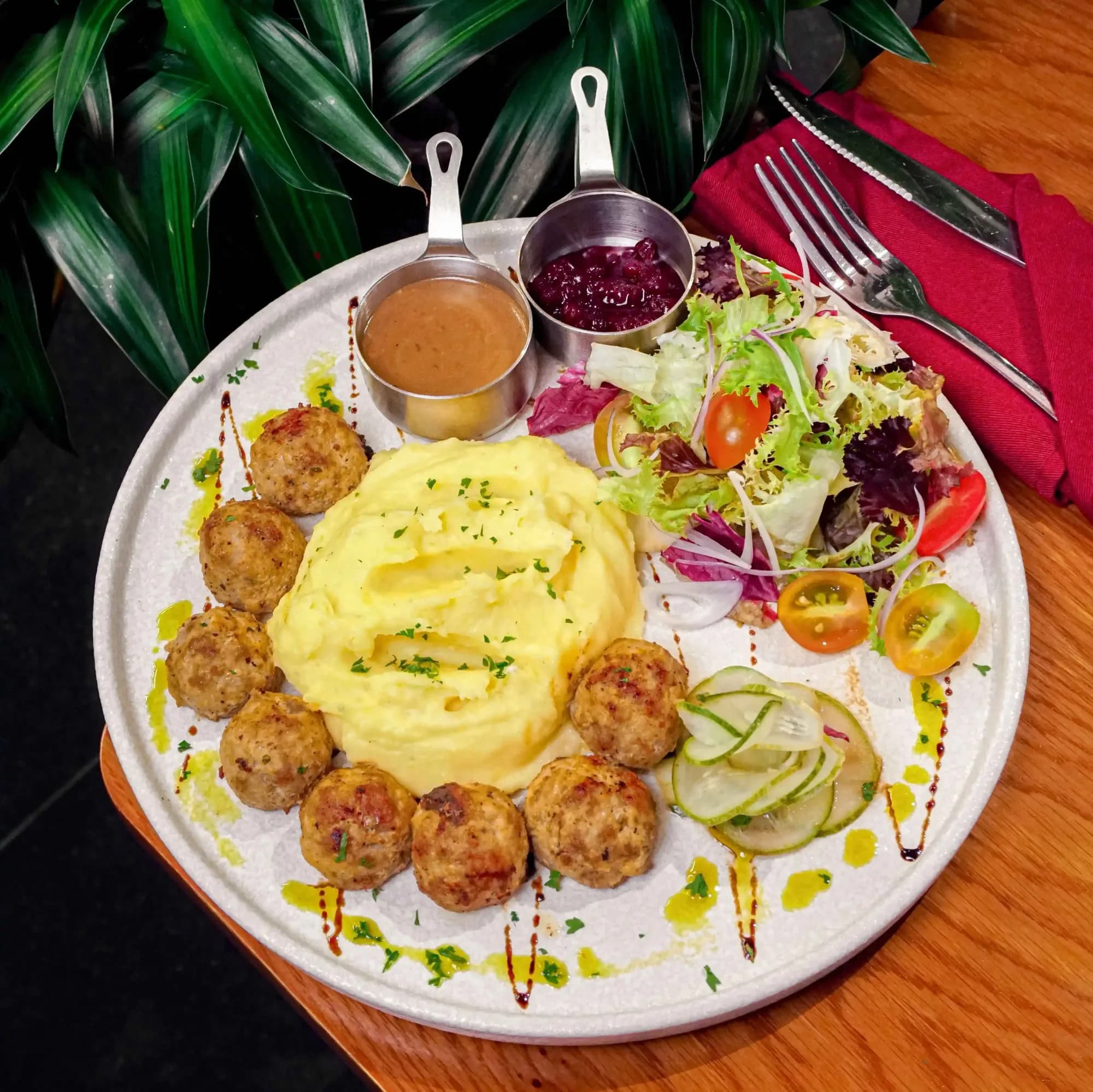
Köttbullar, Swedish meatballs, are the country's biggest culinary export. They are smaller than the Italian kind and made from beef and pork with a panade (bread soaked in milk or cream), which leaves them soft rather than springy. In Sweden they arrive with mashed potato, cream sauce, pickled cucumber and lingonberry jam. The jam is not dessert here: the sour berry acts as a counterpoint to fatty meat, much as pickled daikon does against grilled pork in Vietnamese com tam. They are eaten whole rather than cut, scooping up sauce as you go.
Salmon gratin and beef ribs are the second line, where the northern "put it in and forget it" logic applies. Long braising at low temperature, no rush, minimal spice. At Stockholm the ribs are 449.000 VND, the salmon gratin 379.000, the meatballs 259.000. These belong to the evening menu: dinner runs from 14:00 to 22:00, and since the kitchen closes at 22:00, a proper hot order means turning up by nine at the latest.
Where a newcomer should start
If you have never eaten Scandinavian food at all, order the meatballs. It is the most legible way in, with no risk of meeting an unfamiliar texture. If you like fish and are not put off by salt, take the gravlax. If you come in the morning and want something familiar, there are eggs benedict at 229.000 or an English breakfast at 239.000; not Scandinavian, but made with the same honesty, and morning is the calmest stretch in the bistro anyway.
Northern cooking suits vegetarians better than it sounds: root vegetables, cabbage and pumpkin are staples there, not a side dish added as an afterthought. The menu has salad chay, pumpkin salad, cauliflower steaks, pesto pasta and vegan pizza. If your group splits into the ones who want to try something new and the ones who want normal food, the second half is covered by pasta at 199.000–259.000, pizza at 129.000–259.000 and burgers at 199.000–239.000.
Fika: why dessert is its own category here
Fika is not a snack but a way of putting in a pause. Coffee plus something sweet, sitting down, and never at your work desk. Kladdkaka is a sticky chocolate cake deliberately underbaked so the middle stays wet. Semla is a bun with almond paste and whipped cream, traditionally eaten before Lent. Ostkaka is a Swedish cheese pie, denser and less sweet than cheesecake. All three cost 79.000–89.000 VND, coffee from 40.000.
For anyone working remotely, this setup lines up conveniently with the building: bistro on the ground floor, coworking on floors two to four, hot desk from 80.000 VND a day, a dedicated desk from 1.500.000 VND a month. Heading downstairs for fika between calls is roughly what the Swedes invented the tradition for.
The address is 43 Lý Tự Trọng, Nha Trang. Open daily from 07:00 to 23:00, kitchen until 22:00, brunch from 07:30 to 14:00, dinner from 14:00 to 22:00. Phone +84 766 436 363, email info@almaxinvest.com. Start with the meatballs or the gravlax and finish with kladdkaka — that is enough to tell whether the northern logic of flavor is for you.