

Guide
Digital Nomad Guide to Nha Trang: Work, Costs, Seasons
6 May 2026 · By Stockholm Team
Nha Trang ended up suiting remote work almost by accident. The city runs along the sea in a narrow strip: the Trần Phú seafront on one side, mountains on the other, and a dozen parallel streets in between where the whole of local life fits. Anywhere in the centre is fifteen minutes by bike from anywhere else. Coffee costs less than a metro ride in Europe, and the sea works all year rather than for two months of the season.
The downside is just as plain: people with laptops arrived here before the infrastructure for them did, and plenty of things you can only work out on the ground. What follows is what usually becomes clear over the first two or three weeks — connectivity, places to work, where the money goes, seasons, and moving around town.
Internet: watch stability, not speed
Home fibre in Vietnam is cheap, and in rented apartments it is usually bundled into the rent along with water and cleaning. For video calls, git push and cloud editors it is more than enough — domestic routes here are good. The catch lies elsewhere: international traffic goes through undersea cables, and those cables break from time to time. On days like that Vietnamese services fly while foreign ones — Google Meet, Zoom, heavy dashboards — start to stutter.
Hence a simple rule: keep a backup. A local SIM with mobile data costs next to nothing, coverage across the city is dense, and tethering off your phone saves a call when the home provider goes down. And if your clients sit in Europe or the US, test ping and packet loss rather than the number on a speed test — those are what decide whether people can hear you.
The second backup is physical. It helps to know in advance a place you can turn up at with a laptop at any hour, early mornings and late evenings included, where the internet does not depend on your apartment. Stockholm at 43 Lý Tự Trọng is open daily from 07:00 to 23:00 — the range that covers both morning calls with Asia and evening ones with Europe.
Where to work: home, cafés, coworking
Home is quiet and free, but two weeks in you discover that the air conditioner blows on your back, that the chair which came with the flat was never meant for eight hours, and that there is nobody to talk to. For introverts it works. For everyone else it is a route to resenting both the job and the city by the end of the month.
Cafés are the Vietnamese classic, with caveats. Not every table has a socket, the music gets louder around lunch, and holding a seat for four hours on a single coffee feels awkward. Fine for two hours of morning focus, almost never for a full day with calls — a confidential conversation in an open room is uncomfortable to hold.
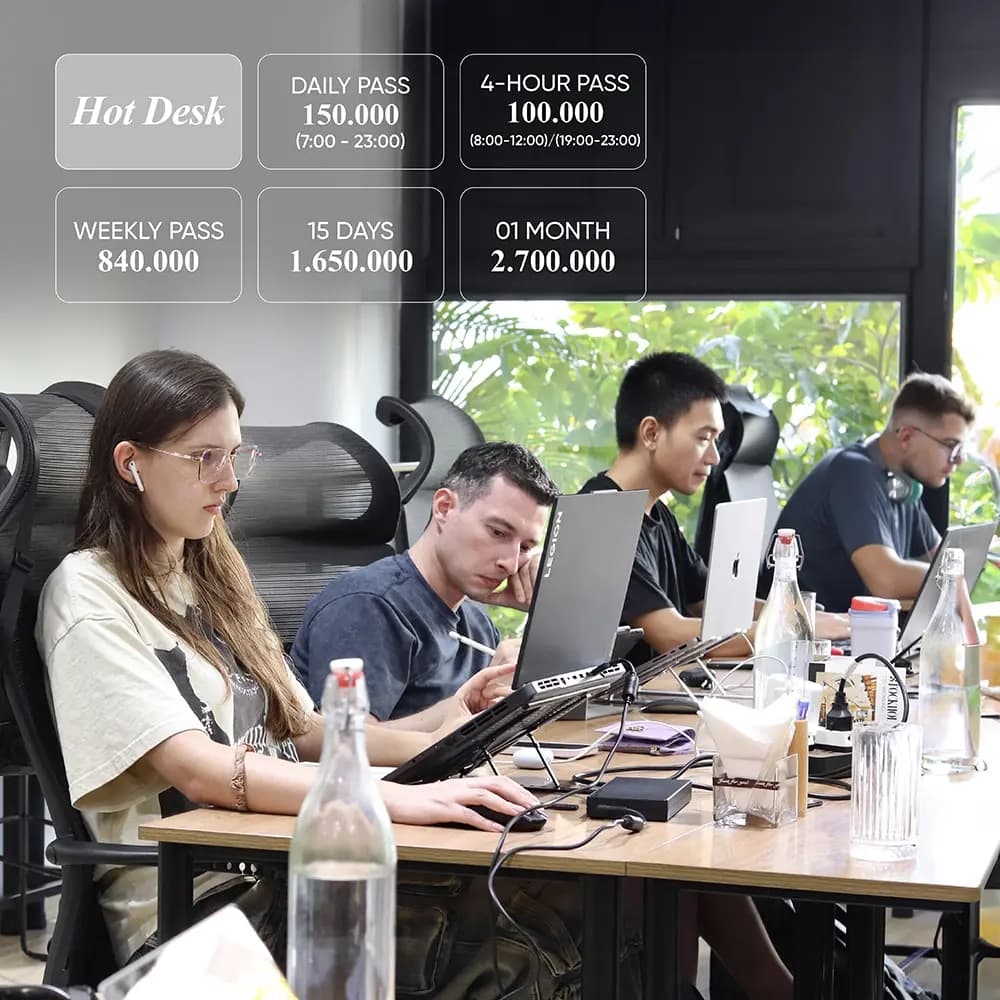
Coworking closes exactly those gaps. At Stockholm the working floors run from the second to the fourth and the bistro sits on the ground floor, so lunch and coffee stop being an expedition into the sun. A hot desk starts at 80.000 VND a day, a dedicated desk at 1.500.000 VND a month, a virtual office at 500.000 VND a month; there are phone booths, meeting rooms, printing, an event hall and private offices on request. The phone booths are the detail people underrate until they have to explain to a client why there is a blender in the background.
What a month costs
Housing is the biggest line and the widest spread. A studio in a building with no sea view and a top-floor flat by the beach differ several times over, and a long contract is always cheaper than month to month. Go and look with your own feet: listing photos in Vietnam live a life of their own, and the real kitchen, the water pressure and the noise from the building site next door only show up in person.
Food splits into three tiers, and most people live somewhere in the mix. Street food and local canteens are the cheapest layer, cooking at home from the market is the second, restaurants with European food the third. For that third tier the Stockholm menu gives easy reference points: Swedish meatballs 259.000 VND, eggs benedict 229.000, gravlax toast 229.000, English breakfast 239.000, pasta 199.000–259.000, pizza 129.000–259.000, burgers 199.000–239.000, coffee from 40.000, and the Swedish desserts kladdkaka, semla and ostkaka at 79.000–89.000. Brunch runs from 07:30 to 14:00, dinner from 14:00 to 22:00, and the kitchen closes at 22:00 — worth checking against if you work European hours and eat late.
Then come the small items that add up to a visible line: transport, mobile service, the gym, laundry, a place to work. Budget separately for healthcare and insurance — they are the two people routinely leave out, and they should not.
Seasons: when to come and when not to
The dry season is the long, predictable part of the year: sun, calm water, a warm sea, and heat that splits the day on its own into work in the morning, a pause through the worst of it and a second shift towards evening. It is the best time for a long stay and the worst for trying to work on a balcony after midday.
Autumn and winter bring rain and wind: the downpours are short but heavy, the sea turns murky, and typhoons come through now and again, writing off a whole day. Those are the weeks when a room with air conditioning, stable internet and coffee nearby proves its value — planning to work in the open air makes no sense.
If your dates are flexible, three to six months timed to land in the dry part of the year is the sensible plan. If they are not, simply keep the cost of a workspace in the budget and a couple of free days in the calendar for whatever the weather does.
Getting around: bike, app, feet
The motorbike stays the most practical way to move: the city is flat, distances are short, and parking exists almost everywhere. Renting by the month is noticeably cheaper than by the day, and haggling is expected. Ride with the correct licence and a helmet — Vietnamese traffic forgives the slow and does not forgive the overconfident.
If you would rather not steer, taxi and moto-taxi apps cover the city densely; a car saves you in a downpour, a motorbike wins in rush hour. The centre around Lý Tự Trọng and the streets beside it is walkable anyway — from home to coworking and back is usually ten to fifteen minutes. Cam Ranh airport is the exception: it lies south of the city, the drive takes about an hour, and it belongs in the plan ahead of time, especially for early flights.
Visas and paperwork: do not improvise
Vietnam's visa rules have changed more than once, and any specific durations, categories and extension conditions go out of date quickly. The only approach that works is checking official sources and local agencies right before the trip, rather than a chat post from six months ago.
The same goes for anything involving work for local companies, taxes and registering a legal entity: that is a subject of its own, where a specialist's advice costs less than the mistake. On the practical side — if you need a Vietnamese address for mail and documents, a virtual office settles it without renting physical space.
Nha Trang rewards the people who come for a long stay and build a routine: mornings for work, the day for the sea, the evening for other people. Everything else — internet, a desk, food, a bike — is infrastructure that either holds that routine up or breaks it. Set it up in the first week.